

Twrc newsroom- Artificial intelligence is rapidly evolving beyond chatbots and content generation. The next generation of AI will consist of autonomous agents capable of executing financial transactions, interacting with decentralized applications, borrowing capital, and making economic decisions without constant human intervention. The question is no longer whether AI agents will participate in decentralized finance—it is what infrastructure will support them.
Magpie Protocol is positioning itself as one of those foundational infrastructure layers.
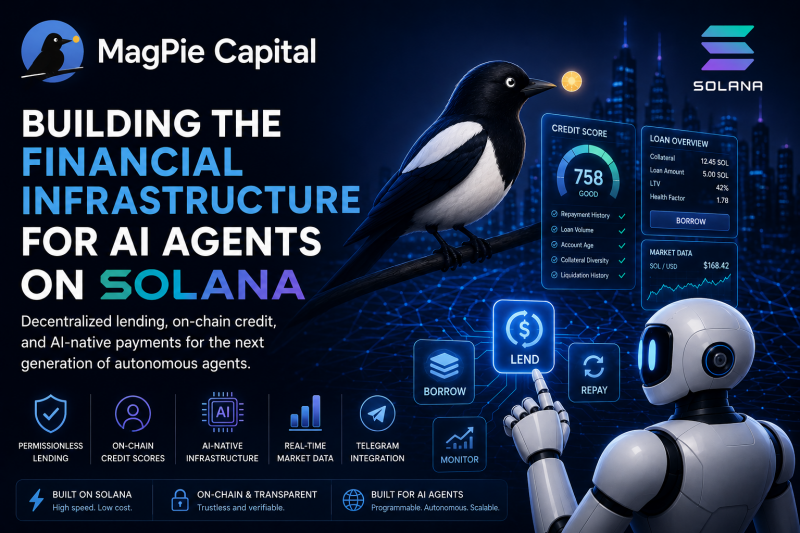
Built on the Solana blockchain, Magpie combines decentralized lending, on-chain credit scoring, and AI-native payment architecture into a single protocol designed for both human users and autonomous software agents. Rather than creating another lending platform, Magpie is building programmable financial primitives that intelligent systems can integrate directly into their workflows.
AI Agents Need Financial Infrastructure
Autonomous AI agents require more than large language models. They require access to capital, identity, reputation, payment rails, and programmable financial logic.
Without these components, an AI agent cannot:
- Borrow liquidity
- Build verifiable financial reputation
- Execute trustless transactions
- Interact with decentralized applications
- Manage collateral automatically
Magpie addresses these challenges by providing a permissionless lending protocol built on Solana's high-performance blockchain. Magpie's core protocol is written using the Anchor framework, one of Solana's primary smart contract development environments.
The protocol manages:
- Loan creation
- Collateral custody
- Liquidation logic
- Loan state
- Credit score updates
Everything is executed on-chain through audited program logic instead of centralized decision making. Loan conditions become deterministic and transparent once transactions are confirmed on Solana.
A Credit Score That Lives On-Chain
One of Magpie's most interesting innovations is its on-chain credit system. Traditional finance relies on centralized credit bureaus. DeFi has historically ignored borrower reputation entirely. Magpie attempts to bridge that gap.
Borrowers accumulate a reputation score based upon:
- Repayment history
- Loan volume
- Account age
- Collateral diversity
- Liquidation history
As borrowers establish reliable repayment behavior, better lending terms become available. Since this reputation exists on-chain, it has the potential to become portable across future decentralized applications rather than remaining locked inside a single institution.
AI-Native APIs
Perhaps the most forward-looking component of Magpie is its AI-native architecture. The protocol is designed so software agents can access lending and credit information programmatically rather than through traditional user interfaces.
Instead of requiring:
- user accounts
- API keys
- manual authentication
AI agents can interact directly with protocol services using blockchain-nativ payment mechanisms. This creates an environment where autonomous software can purchase data, evaluate credit, monitor collateral health, and execute financial decisions in real time.
*Real-Time Financial Decision Making
Magpie integrates pricing data through Jupiter's aggregated liquidity infrastructure across Solana decentralized exchanges.
This enables:
- continuous collateral valuation
- automated health monitoring
- liquidation triggers
- instant loan pricing
For AI systems making financial decisions, real-time market data is essential. Intelligent agents cannot rely on delayed information when managing collateralized positions in volatile markets.
*Telegram as an Operational Interface
*One unique aspect of Magpie is its Telegram integration.
Users can:
- create wallets
- borrow SOL
- repay loans
- receive liquidation alerts
- export wallet keys
without installing additional software.
Although designed for human convenience, conversational interfaces may also become useful operational endpoints for AI assistants managing decentralized financial positions on behalf of users.
Why This Matters
The cryptocurrency industry is entering a new phase where autonomous software will increasingly participate alongside human users.
Future AI agents may:
- manage digital treasuries
- optimize liquidity
- rebalance portfolios
- execute arbitrage
- borrow working capital
- negotiate decentralized services
Protocols capable of supporting these autonomous participants will likely become foundational infrastructure within Web3.
Magpie is not simply creating another lending application—it is developing programmable financial infrastructure where reputation, lending, collateral management, and payments can be consumed directly by intelligent software. As AI continues integrating with blockchain technology, protocols that combine decentralized finance with machine-readable financial services may become essential components of the emerging agent economy. The convergence of Solana's transaction throughput, on-chain credit systems, permissionless lending, and AI-native integrations suggests that Magpie is building for a future where software agents become active participants in decentralized financial markets—not merely observers.This article is based on the current Magpie Protocol documentation and publicly available information from the project.
Add comment
Comments