

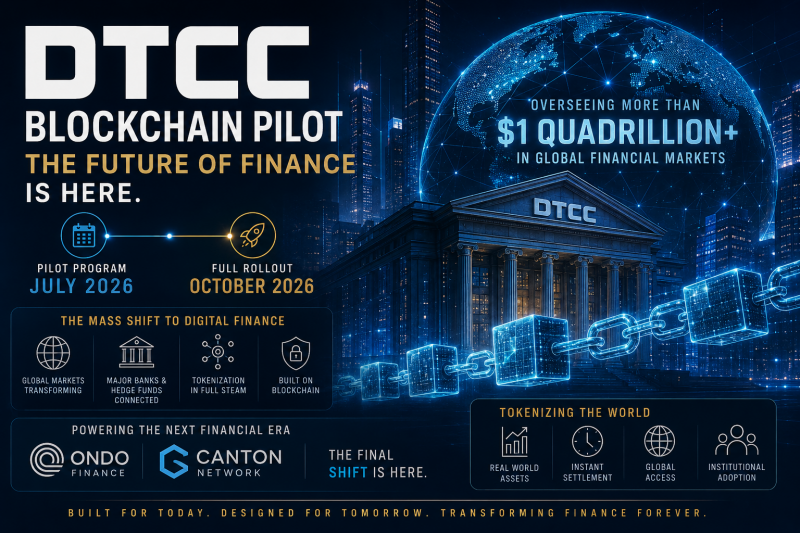
Twrc newsroom- The Depository Trust & Clearing Corporation (DTCC) has announced a pilot program leveraging blockchain technology, set to begin in July 2026, with a full rollout expected by October 2026. At first glance, this may appear to be just another technological upgrade—but in reality, it signals one of the most significant structural shifts in modern financial history.
Why does this matter? The DTCC processes and safeguards transactions totaling over $1 quadrillion annually, acting as the backbone of global financial markets. When an institution of this magnitude begins integrating blockchain infrastructure, it is not experimentation—it is transformation at scale.
This move represents a decisive step toward the digitization of financial assets. Blockchain technology introduces real-time settlement, enhanced transparency, and reduced counterparty risk—features that traditional financial systems have struggled to achieve efficiently. By transitioning core infrastructure onto blockchain rails, the DTCC is effectively laying the groundwork for a new financial paradigm where speed, security, and programmability become standard.
The implications extend far beyond one organization. Major banks, hedge funds, and financial institutions worldwide are deeply interconnected with the DTCC. As these entities adapt to the new system, the ripple effects will be felt across global markets. While “overnight” change may be an exaggeration, the acceleration toward blockchain-based finance is undeniable and likely to compress what would normally take decades into just a few years.
At the center of this evolution is the push toward tokenization—the process of converting real-world assets such as bonds, equities, and real estate into digital tokens on a blockchain. Platforms like Ondo Finance and networks such as Canton Network are already building the infrastructure to support this transition. These systems aim to bridge traditional finance with decentralized technology, enabling seamless movement of capital across previously siloed markets.
What we are witnessing is not just the adoption of a new technology, but the re-architecture of financial markets themselves. Settlement cycles could shrink from days to seconds. Liquidity could become more accessible. Assets that were once illiquid or difficult to trade may become globally available with fractional ownership.
The DTCC’s initiative signals that blockchain is no longer confined to the edges of finance—it is moving directly into its core. As this pilot progresses toward full implementation, it will likely serve as a blueprint for other market infrastructures around the world.
The shift to digital, tokenized finance is no longer theoretical. It is being built, tested, and deployed by the very institutions that have defined the global financial system for decades.
Cites
- Depository Trust & Clearing Corporation. (2024–2026). Digital Asset Strategy and Blockchain Initiatives.
- Canton Network. (2023). Institutional Blockchain Infrastructure Overview.
- Ondo Finance. (2024). Tokenization of Real-World Assets.
- World Economic Forum. (2023). The Future of Tokenization and Financial Market Infrastructure.
- Bank for International Settlements. (2023). Tokenisation and the Future of Money and Financial Markets.
Add comment
Comments