

Twrc newsroom- The global financial system is entering a period of structural change. For decades, ownership of stocks, bonds, real estate, commodities, private credit, and other financial assets has been recorded and transferred through separate systems operated by banks, brokers, custodians, exchanges, clearinghouses, and government registries.
These systems support the modern economy, but they can also create operational friction. Transactions may require multiple intermediaries, reconciliation between separate databases, restricted operating hours, and settlement processes that take time to complete.
Asset tokenization offers a different approach.
Tokenization is the process of representing ownership rights, financial claims, or interests in real-world assets as digital tokens recorded on a blockchain or another distributed ledger. Instead of relying exclusively on conventional databases and paper-based documentation, institutions can use programmable digital infrastructure to record ownership, automate certain transactions, and coordinate the movement of assets and payments.
The concept is no longer limited to cryptocurrency experiments. Banks, asset managers, financial-market infrastructure providers, and regulators are actively developing systems to support tokenized financial products.
The Bank for International Settlements has identified tokenization as a potential foundation for a next-generation monetary and financial system, while the Depository Trust & Clearing Corporation (DTCC) is preparing infrastructure to support tokenized securities within established U.S. financial markets.
The central question is no longer simply whether assets can be tokenized. It is how quickly the technology, regulatory framework, and financial infrastructure can mature enough to support widespread adoption.
The most realistic outlook is that tokenization will expand significantly between 2026 and 2030, with broader integration across financial markets continuing into the 2030s. A completely tokenized global financial system is not yet a scheduled or guaranteed outcome.
1. What Exactly Is Asset Tokenization?
Asset tokenization converts an ownership interest or financial claim into a digital token that can be recorded, transferred, and managed through programmable infrastructure.
The underlying asset may remain in traditional custody. For example, a regulated custodian might hold government bonds while a blockchain records digital tokens representing eligible ownership interests in those bonds.
In other arrangements, the issuer can integrate distributed ledger technology directly into its official ownership records.
The legal structure is critical. A token does not automatically establish ownership of an asset merely because it references that asset. The rights attached to the token depend on the governing documents, the issuer, applicable law, custody arrangements, and the mechanism used to recognize ownership.
How the process works
1. Identify the asset. An issuer selects an asset, such as a Treasury bond, investment fund, property interest, or corporate security.
2. Establish the legal rights. The issuer determines what the token represents, including ownership, income rights, redemption rights, and transfer restrictions.
3. Create the digital representation. Tokens are issued through a blockchain or another distributed ledger.
4. Connect the asset to its records. Custody arrangements, official ownership registers, legal documents, and compliance systems establish how the token relates to the underlying asset.
5. Enable transfers and settlement. Eligible participants can transfer tokens, potentially alongside digital cash, under programmed rules.
6. Manage the asset throughout its lifecycle. Smart contracts and supporting systems may automate distributions, interest payments, corporate actions, collateral management, and redemptions.
The objective is not simply to place an asset on a blockchain. It is to connect ownership, compliance, payments, and settlement within a more coordinated financial system.
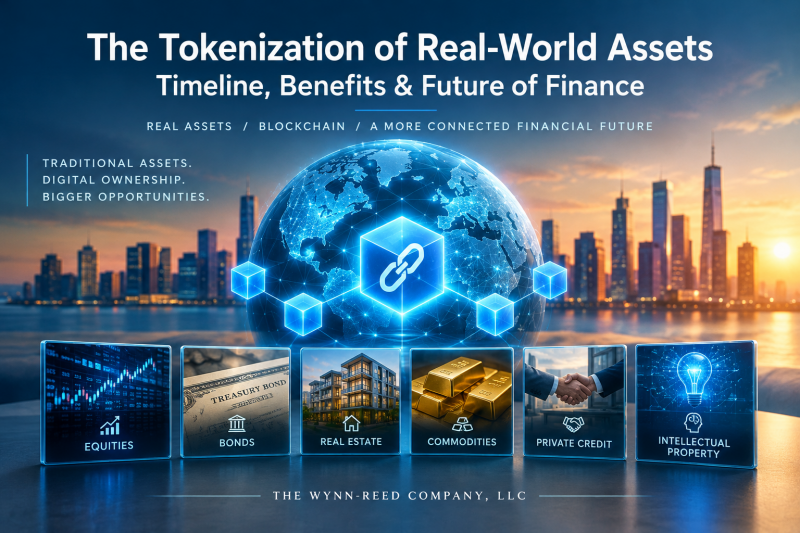
2. Which Assets Can Be Tokenized?
Tokenization is applicable to a broad range of asset classes, although each category presents different legal, technical, and liquidity challenges.
Public equities and exchange-traded funds
Stocks and ETFs can be represented digitally, potentially enabling more flexible transfers, automated corporate actions, and integration with blockchain-based financial applications.
However, a token representing a stock is not necessarily the same as owning the stock directly. Some products represent custodial interests, while others provide synthetic price exposure through a separate financial instrument.
Investors must determine whether a token provides shareholder rights, voting rights, dividends, legal ownership, or only contractual exposure to an asset's price.
Government and corporate bonds
Government bonds are among the strongest early candidates for institutional adoption because their ownership, cash flows, and settlement requirements are already supported by established financial infrastructure.
Tokenized Treasury products can represent interests in short-term government securities or funds holding those securities. Potential benefits include more efficient transfers, programmable collateral, and improved integration with digital cash.
Corporate bonds may also benefit from more streamlined issuance, settlement, interest payments, and secondary-market transfers.
Real estate
Property interests can potentially be divided into digital units, allowing multiple investors to participate in an investment that might otherwise require substantial capital.
Tokenization could simplify parts of investor administration, income distribution, and ownership transfers. Nevertheless, property rights, land registries, taxes, mortgage arrangements, and local regulations still apply.
A token representing shares in a company that owns a building is not necessarily direct ownership of the building itself. That distinction affects the investor's rights and legal protections.
Commodities
Gold and other commodities can be represented by tokens linked to physical reserves or contractual claims.
Gold-backed tokens illustrate how blockchain infrastructure can connect a digital asset with a traditionally traded commodity. Their reliability depends on custody, independent verification, redemption rights, and the legal enforceability of claims against the issuer.
Other possible applications include tokenized interests in energy, metals, and agricultural commodities.
Private credit and alternative investments
Private loans, private credit funds, infrastructure investments, and certain private equity interests may benefit from digital issuance and more automated servicing.
Tokenization could improve recordkeeping, investor reporting, and the administration of complex financial arrangements. It does not eliminate borrower default risk, valuation uncertainty, or restrictions on who can invest.
Intellectual property and other contractual rights
Royalties, licensing interests, and selected contractual cash flows can also be represented digitally, provided the underlying rights are legally transferable and adequately documented.
Across all these categories, the common principle is the same: blockchain can improve how rights are represented and administered, but the quality of the underlying legal claim remains essential.
3. Why Financial Institutions Are Moving Toward Tokenization
The strongest institutional case for tokenization is operational efficiency rather than speculation about cryptocurrency prices.
Faster settlement
Traditional securities transactions often involve separate trading, clearing, settlement, and recordkeeping processes. Tokenized systems can potentially coordinate asset transfers and payment obligations more closely.
Where the infrastructure supports it, delivery-versus-payment can exchange an asset and its payment together, reducing the risk that one side completes its obligation while the other does not.
Programmable financial assets
Smart contracts can automate predefined instructions. A tokenized bond, for example, could be linked to rules governing interest payments, eligible holders, transfer restrictions, and maturity.
Automation can reduce manual processing, but it also introduces software, governance, and operational risks.
Improved collateral efficiency
Financial institutions frequently post securities as collateral for loans, derivatives, and other obligations. Tokenization could make eligible collateral easier to transfer, track, and reuse under agreed rules.
This is one reason institutional initiatives are exploring securities lending, repurchase agreements, and collateral management on digital infrastructure.
Potentially broader market access
Digital distribution may reduce some administrative barriers to accessing investment products and support fractional investment structures.
However, fractionalization does not automatically make an investment available to everyone. Securities laws, investor eligibility, minimum investment rules, geographic restrictions, and platform policies can still limit participation.
More integrated financial services
A tokenized asset may be usable across multiple compatible applications, subject to the issuer's permissions and legal restrictions. In principle, this could connect investment products with lending, trading, payments, and collateral systems.
That potential is often described as composability: financial services can interact through shared digital infrastructure rather than relying entirely on separate intermediaries and databases.
The challenge is ensuring that those connections preserve legal rights, operational controls, and financial stability.
Add comment
Comments